Candidate Pipeline Automation Software That Moves
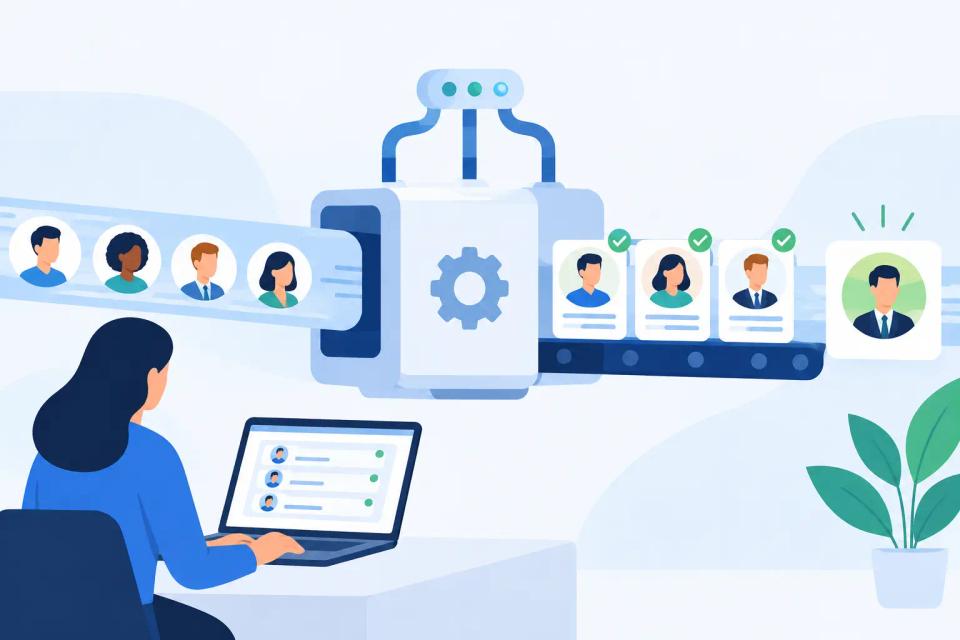
A full requisition should not create a full-time resume review project. When hundreds or thousands of applications enter the same role, recruiters need a way to identify fit, start screening, and keep candidates moving before strong applicants accept another offer. Candidate pipeline automation software turns that backlog into an active workflow instead of a queue waiting for manual attention.
For high-volume employers, the value is not simply doing the same work faster. It is redesigning the sequence of work. The system should prioritize the right applicants early, trigger the next appropriate action, and give recruiters clear exceptions to manage. That reduces repetitive review without removing human judgment from decisions that require it.
What candidate pipeline automation software should automate
The best automation starts after a candidate applies and continues through every predictable step before an interview or hiring decision. It should not merely store applicants, send generic emails, and call that pipeline management. A true automation layer connects evaluation, outreach, screening, and progression.
First, it scores and ranks applicants against the role's defined requirements. Recruiters should see the most relevant candidates first rather than working chronologically through every submission. For a warehouse role, availability, location, shift alignment, and relevant experience may matter most. For a customer support role, communication experience, schedule requirements, and job-specific qualifications may carry more weight. The criteria should reflect the job, not a one-size-fits-all rule.
Next, the platform should initiate candidate contact quickly. Delayed outreach is one of the most expensive forms of recruiting friction. A qualified applicant who waits several days for a first response may already be deep into another employer's process. Automated messages and phone screens can begin the conversation while recruiter capacity is directed toward candidates who need more tailored attention.
Then, the system should collect structured screening information and route candidates based on the results. This might include work authorization, location, schedule, certifications, pay expectations, role-specific eligibility, and interest. Candidates who meet the defined criteria can advance immediately. Candidates who do not can receive a timely, respectful response rather than disappearing into a silent status.
Finally, pipeline automation should update records and trigger handoffs without requiring a recruiter to perform the same administrative step repeatedly. When a candidate completes a screen, the right hiring manager or recruiter should see the result, the candidate's status, and the recommended next action. That is how a pipeline becomes operational rather than merely organized.
Speed matters, but relevance matters more
Automation can create volume quickly. It can also create noise quickly if the workflow is built around weak matching logic or vague job requirements. Moving every applicant forward does not solve recruiter workload. It shifts the workload to later stages, where interviews and manager time are more expensive.
The strongest candidate pipeline automation software uses the application data, resume information, and screening responses to prioritize candidates with the clearest fit. This gives recruiting teams a more useful starting point: a ranked group of candidates with evidence behind their placement, not a larger stack of profiles.
That distinction matters for employers that hire continuously. Retail, hospitality, logistics, healthcare support, customer operations, and staffing teams often face recurring demand, short hiring windows, and applicant pools that change by the hour. They need consistent throughput, but they also need to avoid sending unqualified candidates into interviews just to maintain activity.
There is a trade-off. Highly restrictive filters can eliminate people who could perform well with training or whose experience is described differently on a resume. Overly broad criteria can overwhelm the screening process. The practical answer is to automate objective requirements and early qualification signals while leaving room for recruiter review in edge cases. Recruiters should be able to adjust criteria, inspect why an applicant was prioritized, and override a recommendation when context warrants it.
Build the workflow around candidate momentum
A recruiting pipeline is only as efficient as the candidate's willingness to continue through it. Long gaps, repeated data entry, unclear next steps, and slow scheduling create drop-off even when the role is attractive. Automation should reduce those points of friction.
That starts with a focused application process. If a candidate has already provided information in a resume, asking them to re-enter every field before they can be considered creates unnecessary abandonment. The next step should feel immediate and relevant: confirm a detail, complete a short phone screen, select availability, or schedule a conversation.
Automated phone screens are especially useful when teams need to evaluate large applicant pools consistently. Every candidate receives the same initial questions, responses are captured in a structured format, and recruiters can review the results without coordinating hundreds of individual calls. For roles with straightforward qualification requirements, this can move candidates from application to a meaningful screening outcome in minutes rather than days.
Candidate communication should remain specific. A generic message saying "we received your application" does little to build momentum. A useful automated message tells the candidate what happens next, what information is needed, and how quickly they can expect an update. Even a rejection or hold message is better when it is timely and clear.
This is also where a two-sided platform model can improve results. Employers want qualified applicants to move quickly. Job seekers want relevant opportunities and less application repetition. UpGig supports both sides by matching candidates to fitting roles, helping them apply, and moving qualified people into automated evaluation and screening workflows. The result is not just a cleaner employer database. It is a faster path from job discovery to candidate action.
Where recruiters should stay in control
Pipeline automation works best when it handles repeatable work and creates better decision points for people. It should not become a black box that makes hiring decisions without accountability.
Recruiters and hiring managers should retain control over the requirements that define qualification, the questions used in screening, the candidates selected for interviews, and the escalation rules for exceptions. A candidate may have an unconventional career path, a resume gap, or transferable experience that does not fit a simple keyword pattern. Those cases deserve review, especially for roles where potential and coachability matter as much as prior titles.
Teams also need a process for monitoring outcomes. If screened candidates are consistently failing manager interviews, the criteria may be too loose or the screen may be asking the wrong questions. If strong candidates are being rejected before review, the workflow may be too rigid. Automation provides the data to spot those patterns, but teams still have to act on it.
Compliance and candidate fairness belong in the operating model as well. Use job-related criteria, apply them consistently, protect candidate data, and ensure that automated steps do not create barriers for people who need another path to participate. High-volume hiring does not excuse unclear standards or poor candidate treatment. In fact, a well-designed automated process makes consistency easier to maintain.
How to evaluate candidate pipeline automation software
Before comparing platforms, define the bottleneck you need to remove. Some teams need faster resume triage. Others need more completed screens, faster scheduling, better candidate re-engagement, or visibility across high-volume requisitions. The right system addresses the constraint that is slowing hiring now, while giving the team room to expand automation later.
Look for four practical capabilities:
- Resume scoring and ranking that surfaces the strongest candidates quickly and shows recruiters the basis for prioritization.
- Automated phone screening that collects consistent responses without adding recruiter call volume.
- Workflow progression that advances qualified candidates, sends status communications, and routes exceptions to the right person.
- Reporting that connects pipeline activity to time-to-screen, completion rates, interview conversion, and hiring outcomes.
Integration needs depend on the current stack. If an organization already relies heavily on an applicant tracking system, the automation platform must fit into existing requisition, candidate record, and reporting processes. If the existing system is mostly a repository with limited workflow capability, a more complete operating system may deliver greater value. The key question is not whether a platform has a long feature list. It is whether recruiters can run a faster, more consistent process without creating duplicate work.
Implementation also deserves attention. A platform can score resumes and send outreach on day one, but its impact depends on clean role definitions, practical qualification criteria, and a clear plan for who handles escalations. Start with one or two high-volume roles, measure the time from application to screening, and refine the workflow based on actual candidate behavior.
The hiring team should not have to choose between speed and a thoughtful candidate experience. When automation scores, screens, and moves people at the right moments, recruiters get time back for the conversations that actually change hiring outcomes. That is the standard worth setting for every high-volume pipeline.
Spend less time on resumes
UpGig scores and ranks every applicant so you only call the best ones.
Start your free trial